Posts

Showing posts with the label Himachal

SA Travel Diaries - The Erstwhile Palace of Junga by Priyanshu Mehta
Image
You know what is the good part about being an anthropology student? You can indulge yourself in a surprising array of fields without actually deviating from the main discipline. So while I was out there in the little town of Junga, doing an internship in forensics I did not let my archaeological outlook subside and went to this chief attraction of the town- The Old Junga Palace, what the locals addressed as “Purana Mahal”.  Frontage of the Old Junga Palace What I expected to be a significant monument with huge stone walls actually turned out to be an ancient half-wooden palace falling into gentle ruins. Before getting into the very details of  how the palace looks like? Who ruled the place? etc.., it is first important for the readers to understand that this blog only intends to blow the dust off of the history of the locale and introduce this badly conserved site to the inquisitive minds of explorers and researche rs.   Running through the daily routin...

SA Travel Diaries : Kangra Fort and Museum by Gauri Singh

Image
The Kangra Fort My first trip to Mcleodganj and Dharamshala, Kangra was so unplanned that I hardly knew anything about the places except for the fact that it was one of the most serene hill stations of country. En route , on the outskirts of Dharamshala, I noticed on a hill, some huge walls and buildings which seemed quite old in structure. An exclusive route leading to it had a signboard of ‘The Kangra Fort, 4 km’. Three days later, we were driving to the place. Gauri Singh is a Member of Citizen Archaeology Wing since June 2016 We first arrived at the Kangra Fort Museum and Art Gallery. It was a small place but a treasure house of a forgotten period in the Indian history. The erstwhile Royal Family of Kangra has dedicated their Museum to honour Maharaja Sansar Chand, their ancestor whose reign was known as the Golden Age of Kangra. Maharaja Sansar Chand inherited the throne of Kangra, when he was just 10 years old. By the age of 21, he had defeated the Mughals...

SA Interviews: The miniature wonders of Kangra by Mayank Singh

Image
Mayank Singh is an Intern at Speaking Archaeologically "At a numaish (exhibition) hosted by the King of Chamba", she begins, "When all the artists were boasting about their skills,one of my family's ancestors painted 100 elephants on a single thread of Dhake ke malmal (fine cotton muslin from Dhaka)." Mrs Nisha Raina tells me this and many tales in the hour-long conversation I had with her. In this article, I have tried to include and summarise all that I could learn about Kangra paintings from the interview. Mrs Raina was born into the family of Raina Brahmins, who migrated from Kashmir and settled in Mangloti village of Kangra around the same time the Mughal Empire collapsed. This spree of migration induced a new blend of the M ughlai miniature paintings and the theme of lustrous green landscapes of the hill states, whose Rajput rulers offered patronage to these migrants. Thus was born-what is now known in history as- the Kangra paintings. Mrs Nis...

SA Travel Diaries- Garli: Into the Heritage Village of Himachal Pradesh by Divyansh Thakur

Image
Divyansh Thakur is a Research Wing Member at Speaking Archaeologically since October 2017 This post is an account of the author's one day trip to Garli, and, is not, by any means the result of a scientific expedition. It is, thus, rid of the jargon, profundity and, as Mark Twain would say, the 'impressive incomprehensibility' of scientific works and, in turn, gives an anecdote of what should be realistically called a picnic. For months, the thought of heading out and exploring the cobbled streets of this small hamlet in Kangra had been pestering me—for a place, so close to home seemed elusively distant. The remedy to it came in form of three battered up scooters, and in companions who did not yet understand the intricacies of Archaeology or the meaning of it. They were all lured in by the irresistible charm of a DSLR camera. I guess we were all a bunch of yokels back home, the object of our desires being fancy little devices, which were, prior to contemporary age, ...

The Speaking Archaeologically Art Restoration at Maharaja Dhaulpur Resid...

Image

Culture Diaries: The Curious Case of Assam's Kamakhya Devi in Himachal

Image
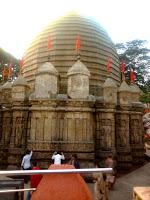
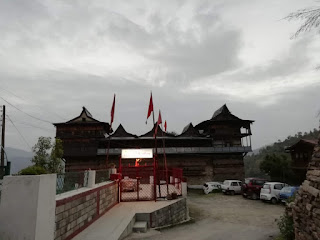
A rather interesting story surfaced at the Lunch table yesterday at a party.Kamakhya Devi or Kamru Devi is a goddess who has been worshiped by the Upper Shimla area Kshatriyas for generations. They worship a tamra patra   or a small metallic pot with water in the name of this Goddess, who, when she possesses a mortal worshiper, asks for her "gaude" (local for ghada or water pot). The very same goddess is worshiped in Kinnaur as Kamru Devi and was apparently introduced in Upper Shimla by one of the ancestors of the Kshatriyas , who had gone to that region for trade. When the river freezes (and I am assuming this is Shyok River and Borasu Pass), the area becomes a trade-route that directly leads to China, and also opens up in Guwahati, Assam. Kamakhya Devi Temple, Assam Interestingly, Guwahati is in the Kamrup District, a famous Shakti Peeth where, interestingly,  there is a temple called Kamakhya Devi. According to Shakti Traditions,  the genitals of the Go...

SA Travel Diaries: The Wonder that was Masrur by Gauri Singh

Image
Gauri Singh is a Speaking Archaeologically Workshop and CArch Member Before visiting the Kangra Valley in July, I made a list of places I wanted to visit. When the name of Masroor came up, it sounded like some distant place in South India. To my surprise, it was located 3 hills away from Mcleodganj on a secluded hilltop. The entire complex was huge and carved out from a single block of sandstone. The entry, now, to the temple is from the rear. There was a small booth along the entrance stairs where we bought the tickets from. As I walked in, I noticed the temple first and then a huge tank of water right in front of the sandstone structure. Knowing it will take me a very long time to explore the temple I chose to go around the water tank first. I could see from the opposite side a complete reflection of the beautiful temple in green waters of the tank which was almost 50 meters wide. From distance a noticed my mother throwing bits of something in water. As I went closer...

SA Travel Diaries: The Daandi Temple of the Ghosts, Kotkhai, Shimla by Shaurya Negi

Image
The view from Daandi The temple at Daandi is placed inside the dense forests of Kotkhai and Balsan tehsils of district Shimla . It can easily be reached by vehicle from Shimla and is approximately  60 k.m. from the main city. The forest belt of Daandi with adjoining villages of Kotkhai This temple has been constructed amidst the deep forests and can be reached by vehicle. The main temple is dedicated to Lord Shiva and is built in a ground. The main temple is made up of stone and cement as it was reconstructed in late 1970’s. Earlier it was made up of stone and wood. According to the locals the temple has its origin since early 1900’s. On festivals like Nag Panchami , Shivratri , Dusshera and beginning on the Monsoon season which according to Hindu religion is dedicated to Lord Shiva the temple is lit up with diyas and lights . The Daandi Temple of Lord Shiva About 50 meters from   Daandi  in the adjoining forest is a shrine built ...