Posts

Showing posts with the label North India

Cut off from the World - Sultan Razia's Tomb, Delhi by Chaitanya Rawat
Image
Down Chawri Bazar roads, into the Bulbulikhana one goes, if they want to find this place. There are scant bulbuls here now, but a regular bustle of people, on by-lanes which grow ever thin as you proceed down them.    A gate next to a tea shop announces, Razia Sultana ki majar , (The Grave of Razia Sultana), but there is none to be found! Good old uncles direct you to even darker alleys, with workshops, sewage, and cramped buildings rising five floors high. A bustle existed there, the sights and smells of fruits, tea, tyres, meat, rickshaws, which are slowly replaced by sewage, machinery, and stagnant water.  This continues till you break away from all that, and arrive at a small mosque, with an ASI stone to give it its name - Sultan Razia’s Tomb. One of the rulers of the newly established Delhi Sultanate, reigning from 1236-40 CE, Razia has been termed the first female monarch of the subcontinent. Constant infighting among her nobles, some of which refused to accept her...

SA Site Cover: Of Mysticism and Transcending Love: Jamali Kamali Mosque, Delhi by Samiksha Purohit

Image
The words of a rather contemporary namesake poet Shayar Jamali, somehow perfectly describes the gloomy conditions of the 16 th century structure: Samiksha Purohit is a Citizen Archaeology Member at Speaking Archaeologically since May 2019. ‘’ Shayad ab kuch kam ho jae mere ghar ki virani,   Makdi jaale taan rahi hai ghar ke roshandaano mein’ ’ The Jamali Kamali mosque stands in the middle of the Mehrauli Archaeological Park, New Delhi. Once a monument with greater glory than its adjacent standing Qutub Minar, is now a supposed haunted place and a safe keeper of the ‘love story’ between its name givers- Jamali and Kamali. Sheikh Fazulla Jalali, or Jamali, a court poet during the reign of Babur, is said to have commissioned the mosque. While the identity of Jamali has a strong historicity attached to it, Kamali on the other hand remains a mystery. A contemporary poet, Jamali’s wife, his servant, his brother, a fictional name to rhyme with Jamali- the anecdotes ar...

SA Site Cover: The Ruins of Payal, Ludhiana by Rattan Kaur Rainu

Image
“Defaced ruins of architecture and statuary, like the wrinkles of decrepitude of a once beautiful woman, only make one regret that one did not see them when they were enchanting.”                                                                                            - Horace Walpole Rattan Kaur Rainu is a Research Wing member at Speaking Archaeologically since August 2018 This blog doesn’t begin on an adventurous note. Neither does it involve a spontaneous road trip. Rather it is the product of an intrigue that drove me to explore a place  I had never even heard of until a few days ago. Goethe said architecture is music. Well, architecture and music are the two things that have always been my favourite. Be it an an ol...

SA Site Cover: The Bhuli Bhatyari ka Mahal by Siddhartha Iyer

Image
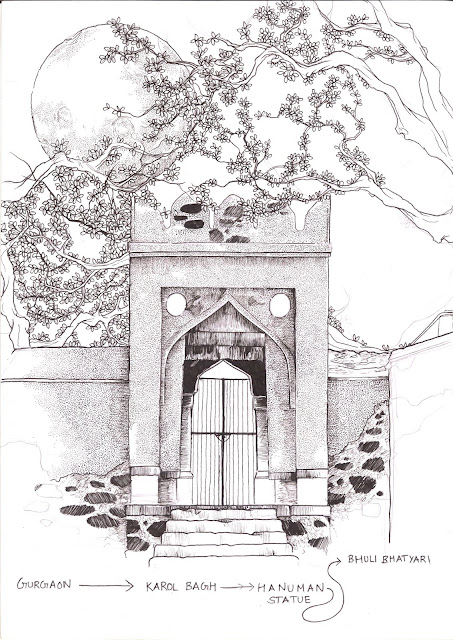
THE BHULI BHATYARI KA MAHAL An oddly disproportional and red Hanuman stands sternly, ripping his chest open as Delhi wizzes by his feet. Many seem almost oblivious to this grand and grotesque gesture. There is a meeting to get to, a date, an assignment to submit a week after it was due, or in most cases just an air conditioner to find and set up base   in front of. Behind the statue, a thin, unassuming road slithers past all the chaos, ending at a place strikingly different from where it began. It ends in the 14 th century, at a now decrepit Tughlaq era hunting lodge. The bhuli bhatyari ka mahal is conveniently tucked away behind the hanuman statue in busy Karol Bagh. It is a spot like so many others in the capital, where the ancient and the modern live cheek and jowl, and hopefully will continue to do so for a long time to come. It faces a large DMNC water tank, where on most occasions, the water turns a rancid green. Every few minutes, the silence around gets in...
Image
SA Travel Diaries : Ashokan Inscription, Kalsi by Gauri Singh The site of Ashoka's Inscription at Kalsi Kalsi is a valley town surrounded by lesser Himalayan mountains from 3 sides and Doon plains on one side, on the confluence of River Yamuna and Tons. It lies about 60 kms from capital city of Dehradun on the road to Chakrata via Herbertpur on the h ighway of Jaunsar region, Dehradun district of state Uttarakhand. The valley is the first plain town when one descends from the Himalayas and is therefore also an economic hub of the Jaunsar-Bawar Tribal Region. Situated at an altitude of 780 meter above the sea level and on the banks of 2 rivers, the place experiences a moderate climate in summers and has scenic surroundings. The alluvial soil drained down by the rivers makes this place one of the most fertile region in the surrounding Pachwa-Doon plains. The place is especially known for The Rock Edict of the great Mauryan emperor Ashoka and is one of the most o...

SA Travel Diaries : Kangra Fort and Museum by Gauri Singh

Image
The Kangra Fort My first trip to Mcleodganj and Dharamshala, Kangra was so unplanned that I hardly knew anything about the places except for the fact that it was one of the most serene hill stations of country. En route , on the outskirts of Dharamshala, I noticed on a hill, some huge walls and buildings which seemed quite old in structure. An exclusive route leading to it had a signboard of ‘The Kangra Fort, 4 km’. Three days later, we were driving to the place. Gauri Singh is a Member of Citizen Archaeology Wing since June 2016 We first arrived at the Kangra Fort Museum and Art Gallery. It was a small place but a treasure house of a forgotten period in the Indian history. The erstwhile Royal Family of Kangra has dedicated their Museum to honour Maharaja Sansar Chand, their ancestor whose reign was known as the Golden Age of Kangra. Maharaja Sansar Chand inherited the throne of Kangra, when he was just 10 years old. By the age of 21, he had defeated the Mughals...